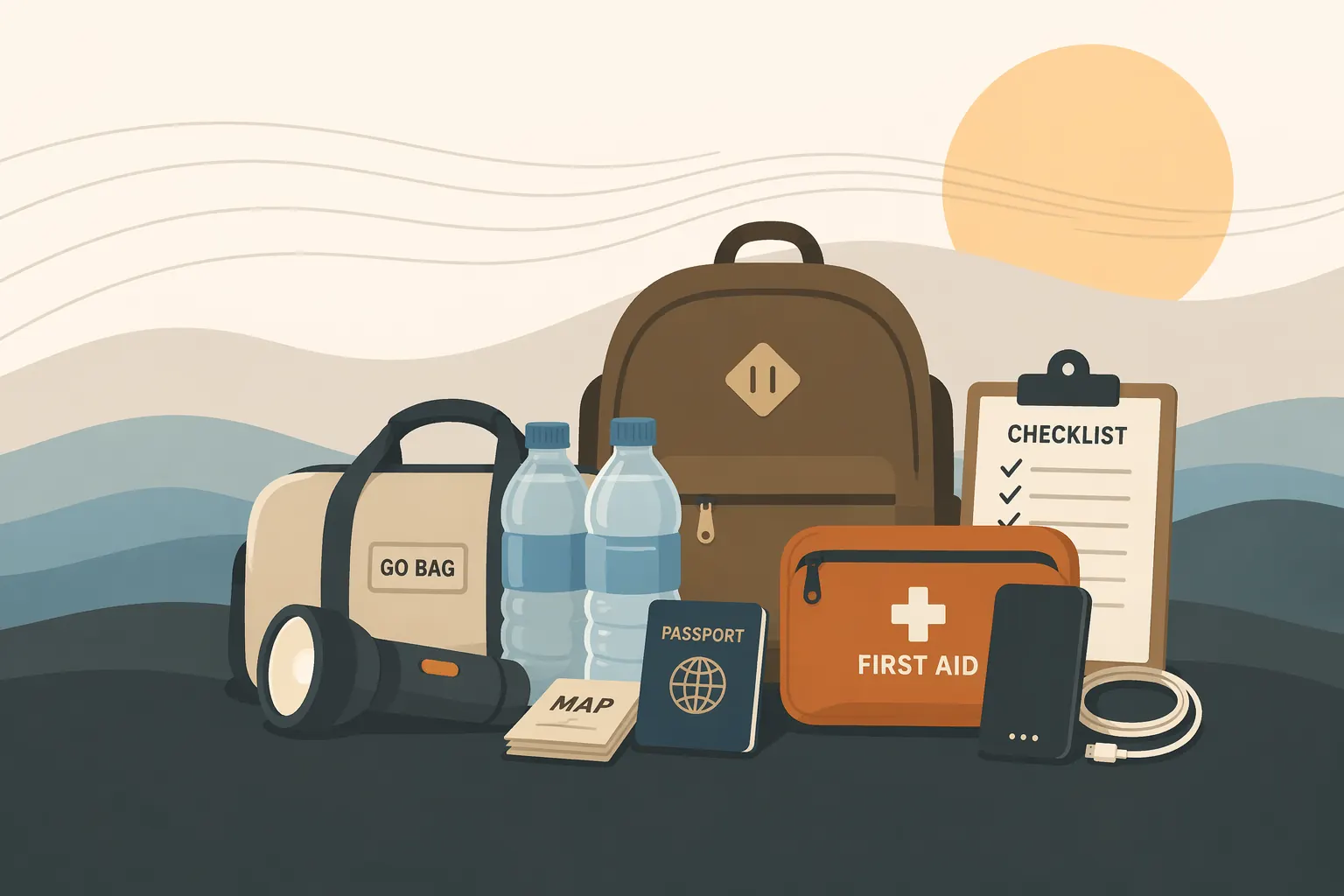
Water
Water is the first thing to run short and the hardest to improvise. Municipal systems fail or become contaminated after hurricanes — often for days. Having your own supply means you're not dependent on distribution points that may be hours away or overwhelmed.
- One gallon of water per person per day — drinking, cooking, and basic hygiene
- Three-day minimum supply (72 hours) — the standard planning horizon for an evacuation kit
- A way to filter or purify additional water (filter or iodine tablets) — for extended situations beyond 72 hours
- A collapsible water container — easier to transport than loose bottles
The math: a family of four needs at least 12 gallons to get through 72 hours. A case of 24 standard 16 oz water bottles is about 3 gallons. You need roughly four cases — or two 6-gallon jugs.
Food
You're not cooking. Power is out, the stove may be on propane you don't want to use, and you may be in a shelter or a car. Pack food that requires no preparation, no refrigeration, and produces minimal waste.
- Three days of shelf-stable food per person — calorie-dense, no cooking required
- Manual can opener (keep two) — the most forgotten item in every kit survey
- A small cooler with ice packs — for the first day before the ice melts, you can extend perishables
- Comfort food and snacks — morale matters, especially if you have children
Aim for roughly 2,000 calories per person per day. Peanut butter, crackers, trail mix, granola bars, and canned beans hit that mark without much volume.
Light
When the power goes out, it goes out completely — no streetlights, no nightlights, nothing. Most people dramatically underestimate how disorienting total darkness is. Flashlights are not a luxury.
- One flashlight per person — not one per household, one per person
- Extra batteries for every flashlight (or use rechargeable with a charged power bank) — batteries drain faster than expected under stress
- At least one headlamp — hands-free, essential if you're doing anything in the dark
- Battery-powered or hand-crank lantern — for ambient light in a room or shelter
Battery shelf life matters. Check the expiration dates on batteries once a year — rotate them out in October, before storm season ends.
Documents
After a disaster, proving who you are is surprisingly difficult. Getting insurance claims paid, accessing benefits, re-entering a closed zone, or enrolling children in a new school all require documentation. Keep copies in a waterproof bag, separate from the originals.
- Photo IDs for every household member — driver's license or passport copies
- Insurance cards and policy numbers — home, auto, health, and renters
- Medication lists with dosages and prescribing physicians — critical if you need care from an unfamiliar provider
- Property deed or lease agreement — or at minimum, your address and landlord contact
- Bank account and credit card information — branch numbers, not just the cards
- Emergency contact list — written out, not just stored on your phone
A USB drive with scanned copies of all these documents, stored in the bag alongside the physical copies, takes minutes to prepare and can be lifesaving.
Medications
One week of medications is the floor, not the goal. Pharmacies close. Supply chains break. If you take something daily, running out isn't an inconvenience — it's a medical emergency.
- Seven-day supply of all prescription medications, rotated monthly so they stay current — rotating prevents stockpiling expired doses
- Over-the-counter basics: pain reliever, antidiarrheal, antacid, antihistamine — stress and unfamiliar food both take a toll
- A spare pair of glasses or contact lenses and solution — vision matters in an emergency
- Copies of all prescriptions, including controlled substances — some require ID for refills at an unfamiliar pharmacy
- Any medical equipment (blood pressure cuff, glucose monitor, nebulizer) and its power adapter — know where you'll charge it if power is out
A note on planning: Contact your insurer about emergency refills before hurricane season. Many will allow a 30-day advance fill once per year for documented conditions.
Communication
Your phone will die. Cell towers will go down. The internet will be unreliable or gone. Plan for a world where none of those things work, because that is the world you will be in.
- A battery-powered or hand-crank NOAA weather radio — the most reliable emergency broadcast system in the US
- A portable battery bank (power bank), fully charged before the storm — one full charge typically equals one to two full phone charges
- A car charger for your phone — your car battery works when the grid doesn't
- A paper list of important phone numbers — you cannot depend on your phone's memory
- A family communication plan: a designated out-of-area contact, a meeting point, and a backup meeting point — decide this before the storm, not during it
NOAA weather radio (NWR) broadcasts continuously from the National Weather Service. It works when cell service doesn't. A battery-powered or hand-crank model costs $20–40 and belongs in every kit.
Comfort and safety
Stress accumulates fast in a displacement situation. For children and elderly family members especially, familiar objects and small comforts reduce it — and that matters for how everyone in the household makes decisions.
- A change of clothes and sturdy shoes for each person — closed-toe shoes matter in debris-strewn environments
- Rain gear — one poncho or jacket per person minimum
- Sleeping bag or blankets — even warm climates get cold in shelters or prolonged outages
- Basic hygiene supplies: soap, hand sanitizer, toothbrush, toilet paper — shelters often run short quickly
- A small first aid kit — the bare minimum, enough to handle cuts, blisters, and burns
- Cash in small bills — ATMs will be down; $100–200 in $5s, $10s, and $20s
- Entertainment for children — a few books, a small game, something familiar