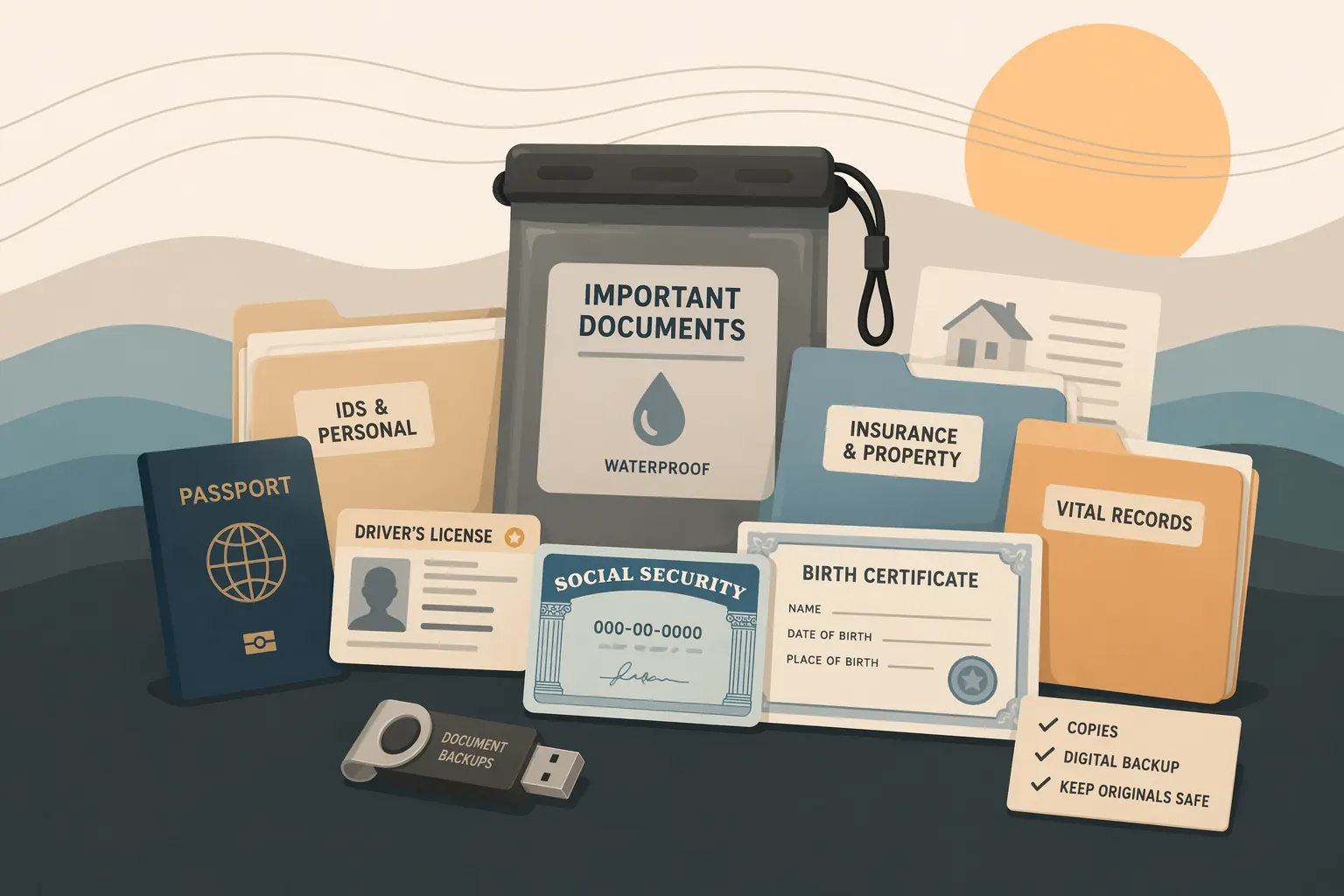
Identity and personal documents
Photo identification is the first thing any organization will ask for. If your wallet is in the house and the house is inaccessible, you need copies. Keep a set with your kit, a set with a trusted contact outside the area, and scanned digital copies in a secure cloud service.
- Driver's license or state ID (copies for every adult) — color copies are more useful than black-and-white
- Passport (copy) — useful for children who don't have a driver's license
- Birth certificates (copies) — required for many assistance applications
- Social Security cards (copies) — required for federal assistance; do not carry originals in your kit
- Marriage certificate or divorce decree if applicable — relevant for insurance and legal purposes
- Naturalization certificate or permanent resident card (copies) — for non-citizen household members
Keep originals in a fireproof safe at home or a bank safe deposit box outside the flood zone. Put copies in your emergency kit. Put digital scans in a password-protected cloud storage account. Three layers is not excessive.
Financial and insurance documents
Insurance claims require policy numbers, coverage details, and proof of ownership. Federal disaster assistance applications require financial documentation. The sooner you can file, the sooner you can access funds — and both processes are significantly slower when you're hunting for documents.
- Homeowner's or renter's insurance: policy number, insurer name, and claims phone number — the first call you'll make after the storm
- Auto insurance: policy number and claims contact — vehicle damage claims are separate from home claims
- Health insurance cards for every household member — essential if you need care at an unfamiliar facility
- Flood insurance policy (separate from homeowner's in most cases) — if you're in a flood zone, know your coverage
- Bank account numbers and institution names — you don't need account numbers memorized if you have them written down
- Recent tax return or W-2 — useful for income verification on assistance applications
- Mortgage or lease agreement — or at minimum, your landlord's name and contact information
- Vehicle title or registration — needed for auto insurance claims and proof of ownership
Medical documents
In a shelter or at an unfamiliar pharmacy, having a written record of your medical history, prescriptions, and insurance means you can get care faster. Verbal summaries are unreliable under stress.
- Medication list: name, dosage, prescribing physician, and indication for each medication — the single most important medical document in an emergency
- Allergy list — medications, foods, and any relevant environmental allergies
- Medical history summary: current diagnoses, recent procedures, and treating physicians — helps any provider who doesn't know your history
- Health insurance card (also in financial section — keep duplicates) — a second copy costs nothing and saves time
- Emergency prescription copies — controlled substances often require ID for refills; having a copy helps
- Pediatric immunization records — required for temporary school enrollment
- Advance directive or living will — if applicable; keep a copy accessible, not locked in a safe
Property and household documents
Documenting what you owned before a disaster is essential for insurance claims and replacement. Many people discover after the fact that they can't prove what furniture, electronics, or valuables they owned because they never wrote it down.
- Home inventory — a room-by-room list or video walkthrough of possessions, stored in the cloud
- Property deed or purchase documents — proof of ownership for insurance and assistance applications
- Vehicle title (for each vehicle) — separate from registration; required for some claims
- Recent utility bills — proof of address for assistance applications
- Mortgage statements — confirms outstanding balance and lender contact for forbearance requests
- Receipts or appraisals for high-value items — jewelry, art, electronics, instruments