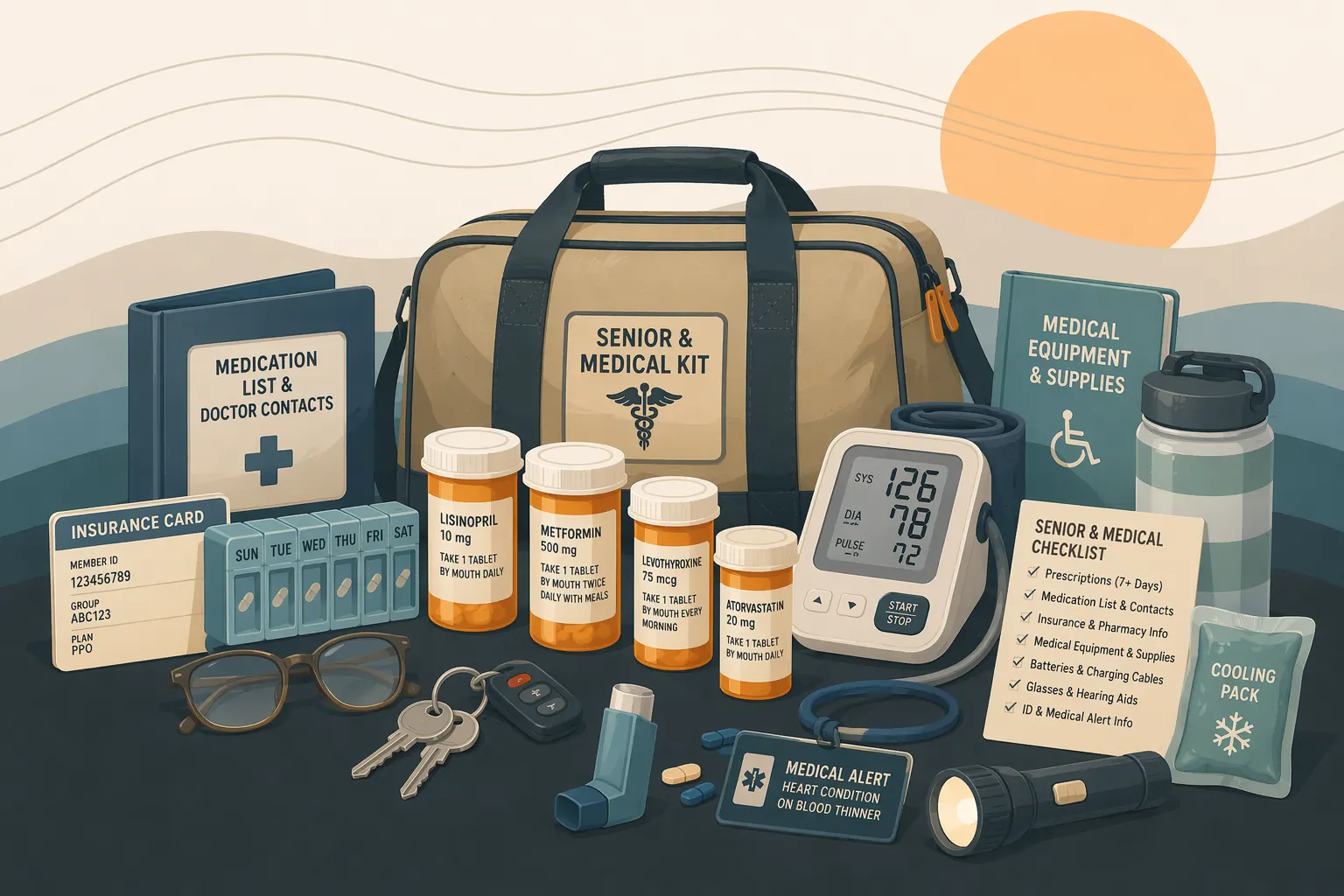
Medications
The standard recommendation is a seven-day supply. That's a minimum. Pharmacies close after hurricanes and stay closed for days. Supply chains for specialty medications can take weeks to restore. Contact your physician or insurer before hurricane season — not during a storm warning — to arrange advance refills, emergency supplies, or mail-order options.
- Seven-day supply of all prescription medications, rotated monthly — more is better for chronic conditions; a two-week supply provides meaningful margin
- A written medication list: drug name, dosage, indication, prescribing physician — one copy in the kit, one with an out-of-area contact
- Insurance card and pharmacy benefit information — required for emergency refills at an unfamiliar pharmacy
- Contact information for your prescribing physicians — including after-hours lines, not just the main office number
- For refrigerated medications (insulin, biologics): a cooler, ice packs, and a monitoring plan — temperature excursions can render these medications ineffective or unsafe
- Controlled substance prescriptions: a copy of the prescription — refills often require ID and original prescription at an unfamiliar pharmacy
Many insurers allow a 30-day emergency advance refill once per year for documented chronic conditions. Ask before storm season — not during a warning when phone queues are hours long.
Powered medical equipment
A power outage is a routine inconvenience for most people. For someone who depends on a CPAP machine, oxygen concentrator, nebulizer, or powered wheelchair, it's a medical event. The planning for this needs to happen before the storm, not during it.
- Know your equipment's power requirements and battery runtime — check the manual or call the manufacturer; this determines what backup power you need
- A UPS (uninterruptible power supply) for lower-draw equipment like CPAP — provides several hours of backup and protects equipment from power surges
- Contact your equipment supplier about emergency rental or loaner units for evacuation — transport of large oxygen equipment is not always practical; know your options before you need them
- Register with your utility company's medical baseline program — households with documented medical needs are often prioritized for power restoration
- If using a portable generator: placement matters — carbon monoxide is fatal indoors; fuel storage is regulated and requires planning
- Contact information for your DME (durable medical equipment) supplier — most have emergency lines staffed during disasters
Heat and cold vulnerability
Older adults are more vulnerable to heat stress than younger people, partly because of physiological changes and partly because many medications affect the body's ability to regulate temperature. Heat exhaustion and heat stroke are genuine risks during extended summer power outages in the South and Gulf Coast.
- Battery-powered or USB fans — significant comfort; not a solution in extreme heat but meaningful in moderate conditions
- Know your nearest cooling center — county emergency management offices list these; locate it before the storm, not after
- Cooling towels and extra water — heat dramatically increases water needs; the standard one gallon per person per day is a minimum
- Discuss heat risk with your physician — some medications (diuretics, beta blockers, anticholinergics) increase heat vulnerability; ask about management before storm season
- A written plan for extreme heat — at what temperature, who to call, where to go; decide this while it's not an emergency
Mobility and accessibility
Evacuation routes, emergency shelters, and disaster response are designed around general population assumptions. If you use a wheelchair, walker, or other mobility aid, or if you have a visual or hearing impairment, your plan needs to account for that specifically — including registering with local emergency management in advance.
- Register with your local emergency management office's special needs or access and functional needs (AFN) registry — this helps authorities reach you if evacuation assistance is needed
- Know that ADA-compliant shelters are available — contact your county EM office in advance to confirm locations and accessibility features
- Extra batteries or a charged backup for powered wheelchairs — and a manual wheelchair as backup if possible
- Hearing aid batteries (extra supply) — hearing aids are not waterproof; have a protection plan and a one-week extra supply
- Glasses or contact lens backup — vision aids are not replaceable on short notice after a storm
- A written communication plan if verbal communication is difficult — a card with key information (name, medical needs, emergency contact) that can be handed to a first responder
Documentation
In a shelter or hospital, having documentation of complex medical history, current medications, and insurance dramatically speeds up care. Providers who don't know you are relying entirely on what you give them. This documentation supplements professional medical guidance — it helps other providers work from accurate information when your regular care team isn't available.
- Complete medication list with dosages, indications, and prescribing physicians — the most critical document for anyone receiving care from an unfamiliar provider
- Medical history summary: diagnoses, significant history, allergies, past surgeries — a single page is enough; this is not a comprehensive record, just the essentials
- Advance directive or living will — keep a copy in the kit, not locked away; a document that can't be accessed can't be honored
- Health insurance card and Medicare/Medicaid cards — required for care at any facility outside your normal network
- Primary care and specialist contact information — written out; other providers may need to call them directly
- Emergency contact list including a person authorized to make medical decisions — clearly identified, with phone numbers that work