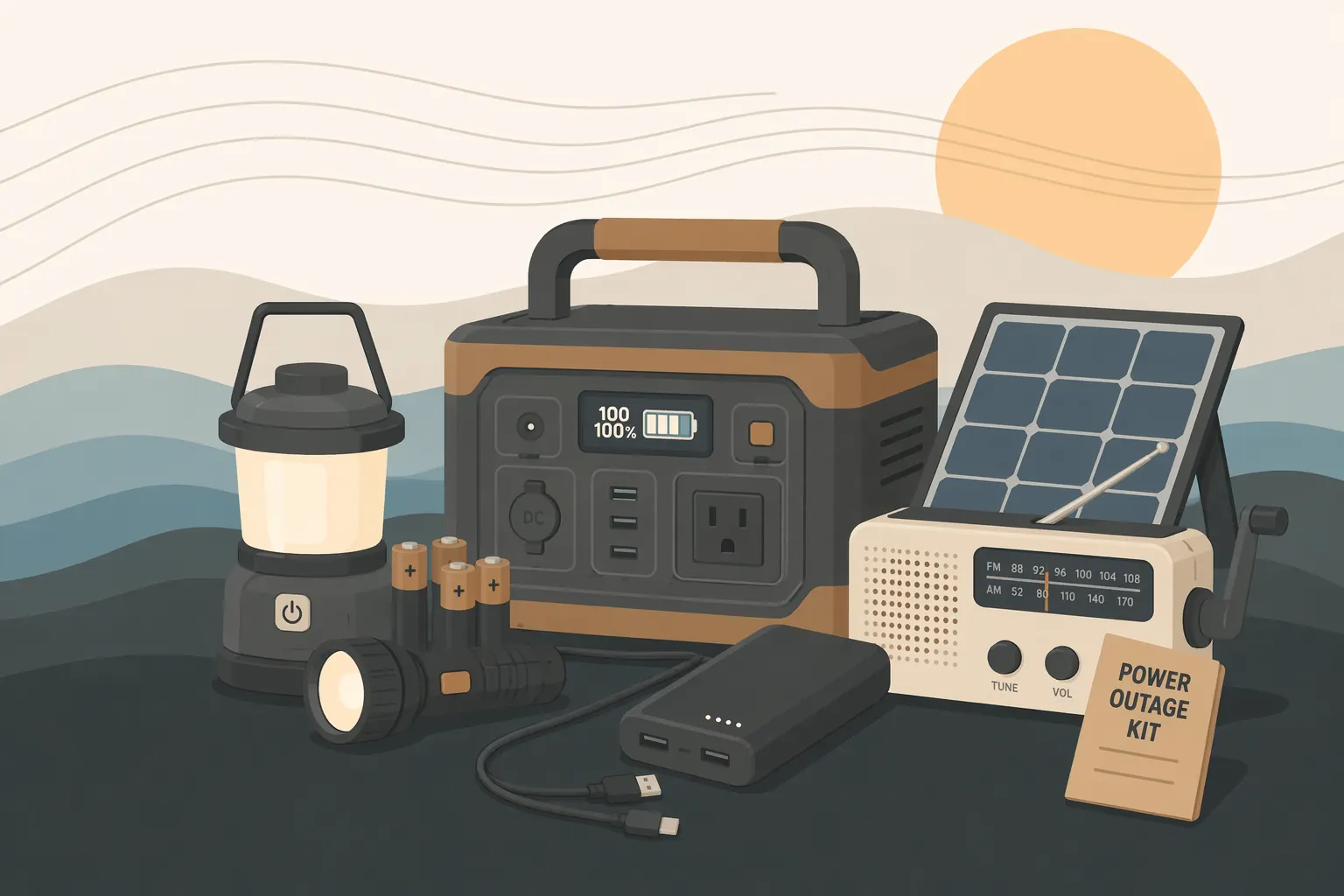
Light and power
Darkness is the most immediate problem when power goes out. After the first night, managing device charging becomes the critical issue — phones are your connection to emergency information, family, and resources.
- Flashlight (1 per person) with extra batteries — one per person, not shared; batteries drain faster than expected under stress
- Headlamp (1 per person) — hands-free light for anything practical
- Battery-powered or hand-crank lantern — ambient room light; candles are a fire risk in storm-damaged structures
- Portable battery bank (power bank), fully charged — at least 20,000 mAh for two charges per phone
- Car charger for phones — your car is a generator for USB charging
- Solar panel charger — if extended outage is likely; charges battery banks during the day
- NOAA weather radio (battery or hand-crank) — receives emergency broadcasts when cell networks are down
A 20,000 mAh power bank costs $30–50 and charges most smartphones two to three times. Charge it before the storm. If you have medical equipment that requires power, factor that into your backup power plan separately.
Food safety
Refrigerators keep food safe for about four hours without power. Freezers hold for 24–48 hours if kept closed. After that, the risk of foodborne illness is real. Know the timeline before you need to make decisions under stress.
- A food thermometer — food is safe if it stays below 40°F; above that, the 4-hour clock starts
- Coolers with ice or ice packs — extend refrigerated food life by 2–3 days if you act fast
- Non-perishable food supply (see food and water kit) — assume the fridge contents are gone after day one
- A camp stove with fuel — for cooking non-perishable food safely (outdoor use only)
- Manual can opener (keep two) — the one item that defeats canned goods if missing
- Shelf-stable milk (boxed), peanut butter, crackers — no refrigeration required
The USDA guidance is simple: "When in doubt, throw it out." Meat, dairy, eggs, and cooked food left above 40°F for more than two hours should not be eaten. The risk is real.
Temperature
Hurricane season overlaps with the hottest months of the year in most affected areas. An extended power outage in August in Florida or Texas is a heat emergency, not just an inconvenience. The elderly, infants, and anyone on certain medications are at significantly higher risk.
- Battery-powered or USB fans — significant comfort in heat; know their limits
- Cooling towels — damp cloth on neck and wrists lowers perceived temperature
- Know your nearest cooling center — your local emergency management office lists these; find it before the storm
- Extra water for staying hydrated — heat dramatically increases water needs
- Space heater (battery or propane, for unexpected cold snaps) — Gulf Coast winters can be surprisingly cold
- Warm layers and blankets — even warm-weather climates can get cold at night without heat
Medical equipment
If anyone in your household depends on electrically powered medical equipment — CPAP, nebulizer, oxygen concentrator, dialysis, powered wheelchair, insulin refrigeration — a power outage is a medical event, not just an inconvenience. Plan for this specifically and in advance.
- Know the runtime of your equipment on battery backup — check the manual
- A UPS (uninterruptible power supply) — provides hours of backup power for low-draw devices like CPAP
- A portable generator or solar + battery system — for higher-draw equipment; generator placement matters (never indoors or near windows)
- Contact your power company about medical baseline status — many utilities flag households with medical needs for priority restoration
- A 7-day supply of refrigerated medications stored with ice packs or a cooler — insulin and some other medications require refrigeration
- Contact your physician and equipment supplier before hurricane season — ask about emergency protocols and rental options
Staying informed
When the power is out, you lose access to the internet, cable news, and anything else that depends on the grid. The most reliable emergency information system in the US during a power outage is NOAA Weather Radio — a network of transmitters that broadcast National Weather Service alerts continuously on dedicated frequencies.
- NOAA weather radio — battery or hand-crank; receives NWS alerts on 162.400–162.550 MHz
- A battery-powered AM/FM radio — local emergency broadcasts on AM; FEMA often coordinates with local stations
- A written list of local emergency contacts — your county emergency management, utility company, and insurance company
- Family communication plan with an out-of-area contact — someone outside the affected area who can relay messages