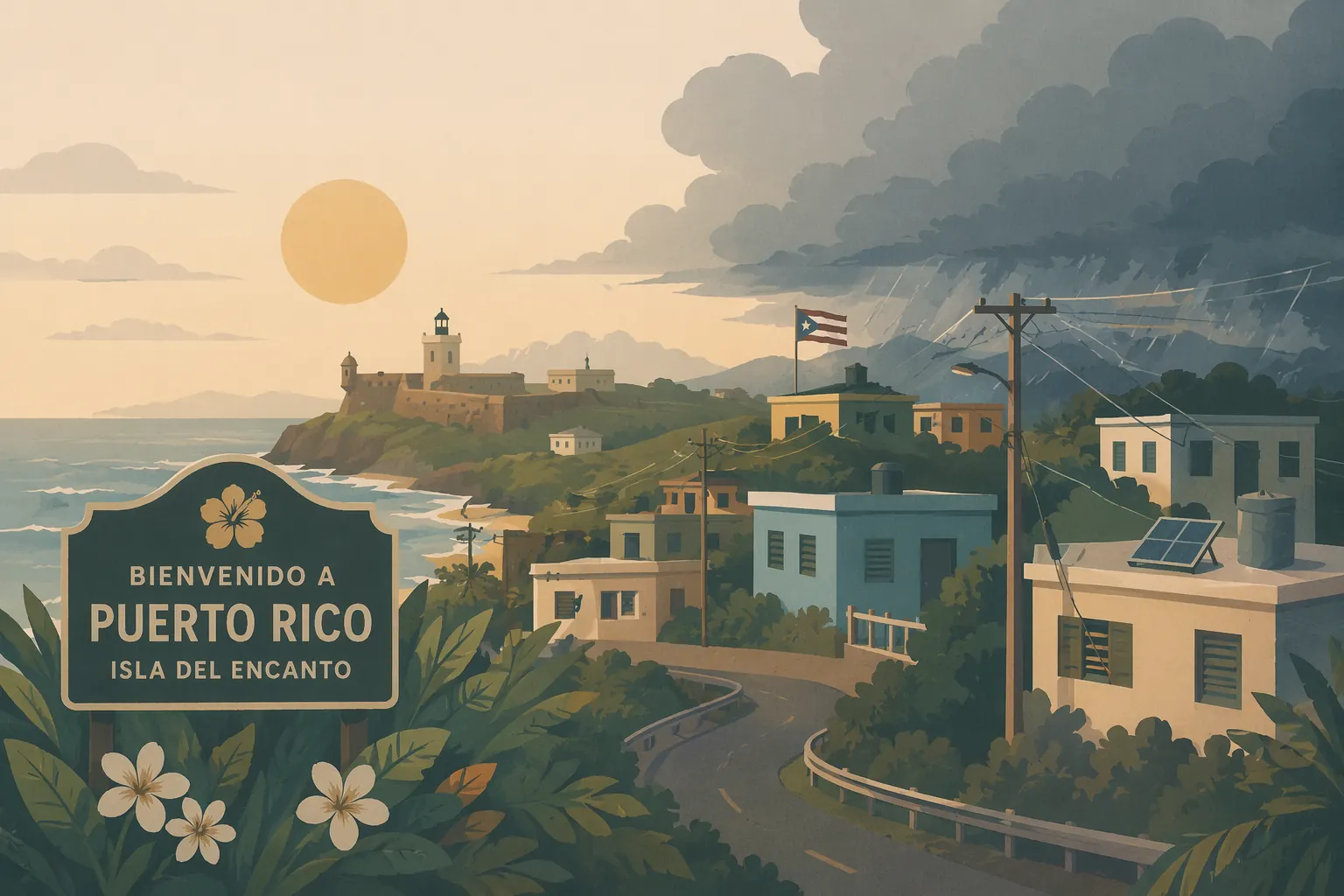
What makes hurricanes here different
- Island geography means supply chains for relief and reconstruction take longer to establish. After Maria in 2017, some areas were without power for 11 months. This is not a reason for panic; it is a reason to stock supplies for a longer duration than mainland guidance suggests.
- The power grid has historically been fragile. Grid rehabilitation has been ongoing since Maria; conditions have improved, but the island's mountainous terrain makes restoration difficult and uneven across municipalities.
- The mountains create orographic rainfall effects — storms can dump extreme rainfall on the windward side of the island, causing catastrophic flooding and landslides in ways not seen on flat coastal areas.
- Multiple simultaneous threats: storm surge on the coasts, flash flooding and landslides in the mountains and foothills, and wind damage across the interior can all occur from a single event.
- Supply chain distance: basic supplies that would arrive within 24 hours on the mainland may take days or weeks after a major event. Two-week supply minimums are appropriate; three to four weeks is not excessive for critical items.
Regional supply additions for Puerto Rico
Standard kit guidance assumes a three-day to one-week planning horizon. In Puerto Rico, a conservative planning horizon for supplies is two to four weeks for a major event.
- Extended water supply: two-week minimum — rather than the standard three-day minimum; water system restoration takes longer post-major event
- A water filtration system (gravity filter or pump filter) — for longer-duration situations beyond stored supply
- Extended food supply: two weeks minimum — supply chain restoration takes longer
- A generator or solar + battery system if budget allows — power restoration may be measured in months in mountain areas after a major storm
- Prescription medications: at minimum two weeks, ideally one month — pharmacies face resupply challenges post-event
- Propane cook stove and fuel — for extended no-power cooking
Official sources to bookmark now
The organizations below are the authoritative sources for evacuation orders, shelter locations, and storm-specific guidance. Bookmark these before the season — not when a storm is approaching, when traffic on these sites is enormous.
- Puerto Rico Emergency Management Bureau (NMEAD) — official Puerto Rico emergency management
- National Hurricane Center — track forecasts and watches/warnings
- Puerto Rico Department of Transportation — road conditions
- Puerto Rico 211 — local assistance
- FEMA Puerto Rico — federal preparedness resources
- Your municipality emergency management office — local evacuation orders and shelter information
Evacuation routes and shelter locations change with each event. Always confirm with your municipal emergency management office.
Historical context
Puerto Rico's documented hurricane history includes some of the most severe events in Caribbean recorded history. The San Felipe Hurricane of 1928 and the San Ciprian Hurricane of 1932 are among the early recorded major events. More recently, Hugo in 1989 and Georges in 1998 caused significant damage and extended outages. María in 2017 is the most recent catastrophic event: it made landfall as a Category 4 with nearly 155 mph winds and caused estimated deaths of approximately 3,000 people (estimates vary by methodology) and total damage estimated at $90 billion. The response to María exposed significant gaps in federal and local emergency response coordination; subsequent planning and investment has addressed some of those gaps. Preparing here means planning for a longer self-sufficiency window than the mainland assumes.
Weather intelligence
Live Puerto Rico wind gusts
A fast live view for checking where stronger gusts are organizing around the island. Use it as context, then verify warnings and local instructions with NMEAD and the National Hurricane Center.
Source: Ventusky. For official warnings, use NMEAD and the National Hurricane Center.